

Do You Need a Referral for Physical Therapy in New York?
Manhattan Physical Therapy

Short answer: no, you don't. In New York, you can walk into a physical therapy clinic and start treatment without a referral. That covers you for up to 10 visits or 30 days, whichever comes first.
But here's the part that trips people up. Being allowed to start PT is not the same thing as your insurance agreeing to pay for it. Those are two separate questions, and this guide walks you through both.
One exception worth flagging right away: if you got hurt at work, the rules change. We'll come back to that.
Can You Really Just Book a PT Appointment?
In many cases, yes. A New York law called Education Law Section 6731 lets an experienced physical therapist treat you without a referral for a short window. People call this direct access.
What does that mean for you day to day? It means you can skip a step. Normally you'd have to book a doctor's visit, sit in a waiting room, get a referral slip, and only then call the PT clinic. Direct access lets you call the clinic first.
When you call, just ask whether the therapist you'd be seeing qualifies for direct access. They should be able to tell you straight away.
The Limit: 10 Visits or 30 Days
Treatment without a referral does not last forever. You get 10 visits or 30 calendar days, and whichever one runs out first ends the window.
A few details that matter here:
The 30 days include weekends and holidays. It's 30 calendar days, not 30 business days.
Both the visit count and the clock start on the day you first get treatment.
If your first appointment is only an evaluation, with no actual treatment, that visit does not count toward your 10. Once treatment starts, though, the clock starts too.
Here are two examples to make it concrete.
Example 1: You go three times a week and finish 10 treatment visits in three weeks. Your window closes at that tenth visit, even though 30 days haven't passed yet.
Example 2: You go once a week and have only had 5 visits. But 30 calendar days have gone by since treatment began. Your window closes anyway, because the 30 days ran out first.
Not Every Therapist Can Treat You This Way
New York asks for a certain amount of experience before a therapist can start treating someone without a referral. To be specific, the PT needs at least 4,320 hours of practice, built up over at least 36 months.
Don't worry, you don't have to do this math yourself. Just ask the clinic one question:
"Do you accept patients under New York direct access?"
That's it. They'll know what you mean.
You Should Get a Written Notice First
Before your treatment begins without a referral, the therapist has to hand you a written notice. This notice warns you that your health plan or insurer might not cover the treatment if there's no referral.
Both of you have to sign and date it. The clinic keeps one copy, and you get one to take home. Why does this matter? Because it spells out the exact gap we mentioned at the start. The law says you can start PT. Your insurance company decides, separately, whether it will pay the bill. Signing that form means nobody can say you weren't warned.
When You Still Need a Referral
Direct access helps a lot of patients get started. Even so, it doesn't wipe out referral rules in every situation. Here are the four cases where a referral still comes into play.

1. When You Need More Treatment Than the Limit Allows
Say your 10 visits are up, or 30 days have passed, and you still need PT. From that point on, treatment usually has to continue under a referral.
Who can write that referral? The New York State Education Department lists these practitioners:
physicians
nurse practitioners
podiatrists
dentists
midwives
Each of them can refer you as long as PT falls within what they're licensed to handle. A physician assistant can also order PT, but only while acting on behalf of a physician.
2. When Your Health Plan Demands One
This is the one that catches people out, so read it twice.
Your insurer can require a referral even when state law says the therapist may treat you without one. New York's own payment guidance says as much: an employer or an insurance payer is free to ask for a referral before it pays anything.
In practical terms, here's how that goes wrong. You start PT legally under direct access. You go to your visits. Then a bill lands in your mailbox, because your plan wanted a referral and never got one.
So call your insurer before your first treatment if you possibly can. A five-minute phone call now beats a surprise bill later.
3. When the Injury Happened at Work
Workers' compensation runs on its own set of rules, and direct access doesn't apply.
The New York State Workers' Compensation Board says the physical therapist needs a referral from your treating medical provider. On top of that, the PT has to be authorized by the Board to treat workers' compensation patients at all.
So if you got hurt on the job, mention it when you book the appointment. Don't assume the usual 10-visit rule covers you here, because it doesn't.
4. When It's Related to a Car Accident
Car accident treatment brings New York No-Fault rules into the picture. That means claim forms, deadlines, and coverage reviews.
Tell the clinic about the accident before treatment starts, and ask what claim information they need from you. The New York Department of Financial Services publishes consumer information about No-Fault claims if you want to read up.
Will Insurance Actually Pay?
Not necessarily. Let's separate the two things one more time, because it's the single most important idea in this article:
New York law decides when a qualified therapist may treat you without a referral.
Your insurance plan decides whether it will pay for that treatment.
One says yes, the other might say no. They're not connected.
What to Ask Your Insurer Before You Go
Call the number on the back of your card and ask whether your plan requires:
a referral for outpatient physical therapy
prior authorization, either before treatment or after a set number of visits
an in-network clinic for the best coverage (Note: This in-network status isn't automatic, by the way. A clinic has to be enrolled and approved with each insurer separately, which is handled through insurance credentialing and enrollment. It's also why a clinic can be in-network with one plan and out with another.)
a cap on covered visits, or check-ins to confirm the care is still needed
a deductible, copay, or coinsurance each time you go
Referral vs. Prior Authorization
These two get mixed up constantly, so here's the difference in plain terms.
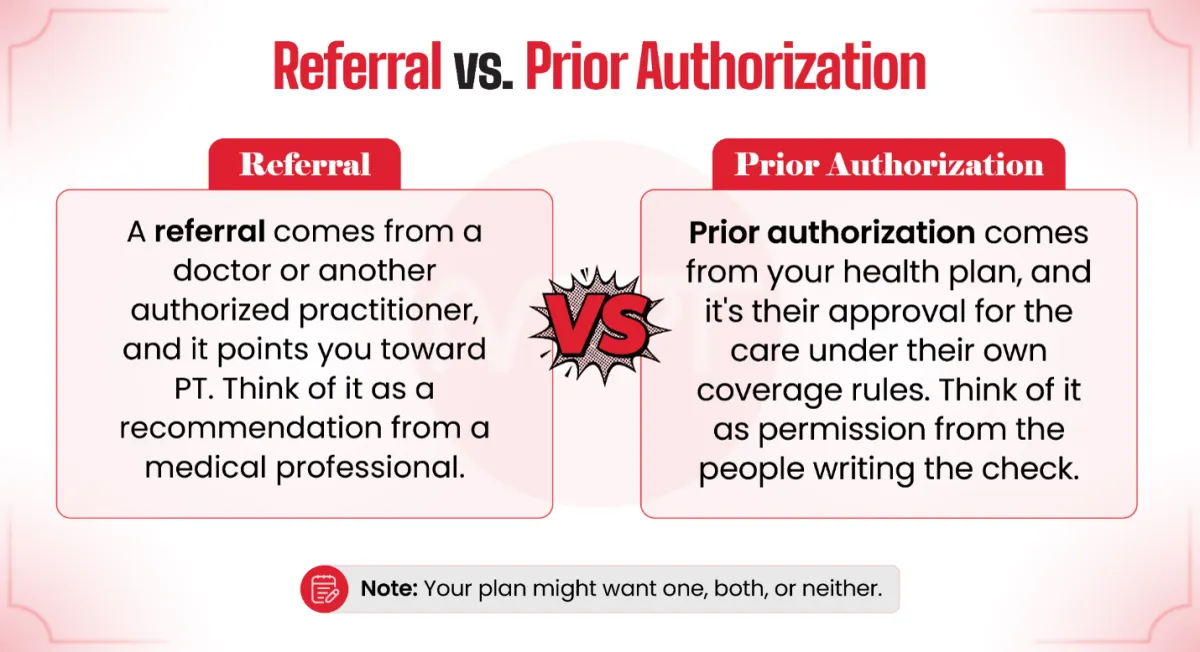
A referral comes from a doctor or another authorized practitioner, and it points you toward PT. Think of it as a recommendation from a medical professional.
Prior authorization comes from your health plan, and it's their approval for the care under their own coverage rules. Think of it as permission from the people writing the check. Your plan might want one, both, or neither.
What You Might Pay Out of Pocket
Three more terms worth knowing, since they show up on every bill:
Deductible: the amount you pay for covered care before your plan starts chipping in.
Copay: usually a fixed amount per visit, like $30 each time.
Coinsurance: a percentage of the cost that's yours to cover.
What If You Have Medicare?
Medicare doesn't fit neatly into a yes-or-no answer on referrals, so let's take it slowly.
With Original Medicare, Part B covers outpatient physical therapy when it's medically necessary and a doctor or another eligible provider certifies that you need it.
CMS guidance explains that an order or referral is one way to show a practitioner was involved. But the thing Medicare actually requires is certification of your therapy plan of care. In other words, you don't always have to turn up at the clinic holding a traditional referral. What matters is that this certification gets handled properly, or Medicare won't pay.
That sounds like paperwork, and it is. Fortunately, it's mostly the clinic's paperwork, not yours. Most practices don't handle it alone either, since many of them lean on medical billing services in New York to get certifications and claims filed correctly. Just ask them two things: do you accept Medicare, and how will you get the plan-of-care certification sorted?
If you have a Medicare Advantage plan instead, call the plan directly. Advantage plans set their own rules on referrals, prior authorization, and which clinics are in network, so what applies to Original Medicare may not apply to you.
Manhattan Physical Therapy
✆ Phone (appointments):
(212) 213-3480
Address: 385 5th Ave, Suite 503, New York, NY 10016


